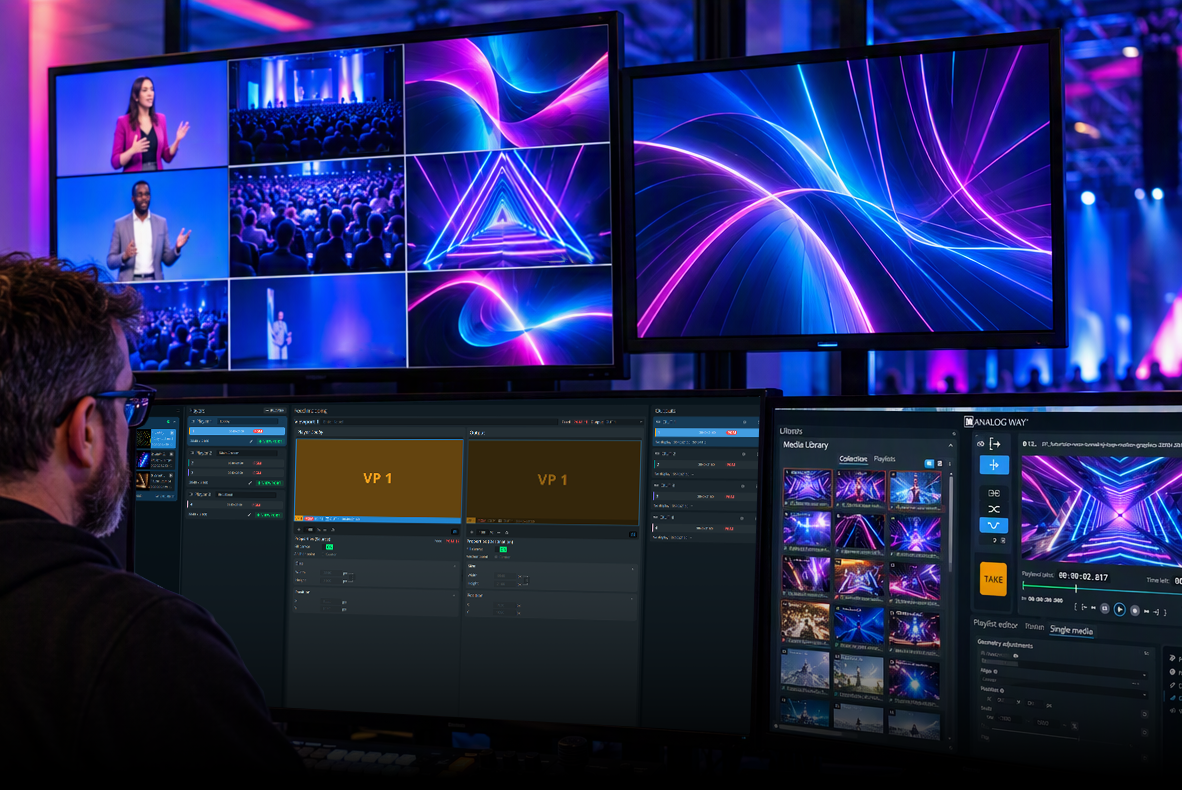
Ask how media playback is categorised and you’ll usually hear two answers. At one end sit simple single-output playback devices — a laptop, a small player, a familiar piece of software running a clip. At the other end sit large, specialist media server ecosystems built for the most complex touring and installation work. The conversation tends to treat those as the only two destinations. In reality, an enormous amount of professional AV lives in thes pace between them.
The market often talks as if media server systems are split into two categories: simple single-output playback, or large-scale specialist systems. But a huge amount of professional AV lives in the space between those two extremes.
What the middle actually looks like
The middle is not a compromise zone; it is where a growing share of real projects sit. Think of breakout rooms that each need their own reliable UHD feed, side screens and sponsor loops running alongside a main stage, mid-scale LED that has grown past what a single output can drive, and corporate or installed environments that need several outputs at once but not a specialist crew to run them. These jobs need multiple outputs, professional I/O, dependable playback, and clear control — without the cost, scale, or operational overhead of a flagship touring server.
When the only options presented are “too little” or “far too much,” teams end up solving a mid-sized problem with the wrong tool. They either stretch a single-output setup past its comfort zone and inherit instability, or they buy into a large ecosystem and pay — in money, training, and setup time — for capability the project will never use.
Why four outputs is becoming a natural centre of gravity
A four-output platform is interesting precisely because it maps onto how modern shows are actually built. Multiple breakout environments, a main canvas plus auxiliaries, or several independent screens can often be served from a single well-designed system rather than a rack of separate ones. That consolidation matters: fewer systems per show means fewer failure points, less to transport, and a simpler mental model for the operator — while still covering the multi-output reality that mid-scale work now demands as standard, not as an exception.
The point is not that everything belongs in the middle. Specialist 3D, XR, and immersive work rightly lives with specialist platforms, and the simplest jobs are well served by the simplest tools. The point is that the middle deserves to be treated as a category in its own right — with products designed for it — rather than as an afterthought squeezed from either end.
If you spec systems, it is worth auditing your recent projects against this lens. How many genuinely needed a flagship’s full depth? How many were quietly under-served by a single output? The answers often reveal that most work has been sitting in the missing middle all along.
See where your project sits
We built a short sizing guide that maps common project types — breakout rooms, auxiliary screens, mid-scale LED — to the output count and capabilities they actually require.
Share your email in the contact form link below and we'll send the guide, and we're glad to sanity-check a specific project with you if it's useful.