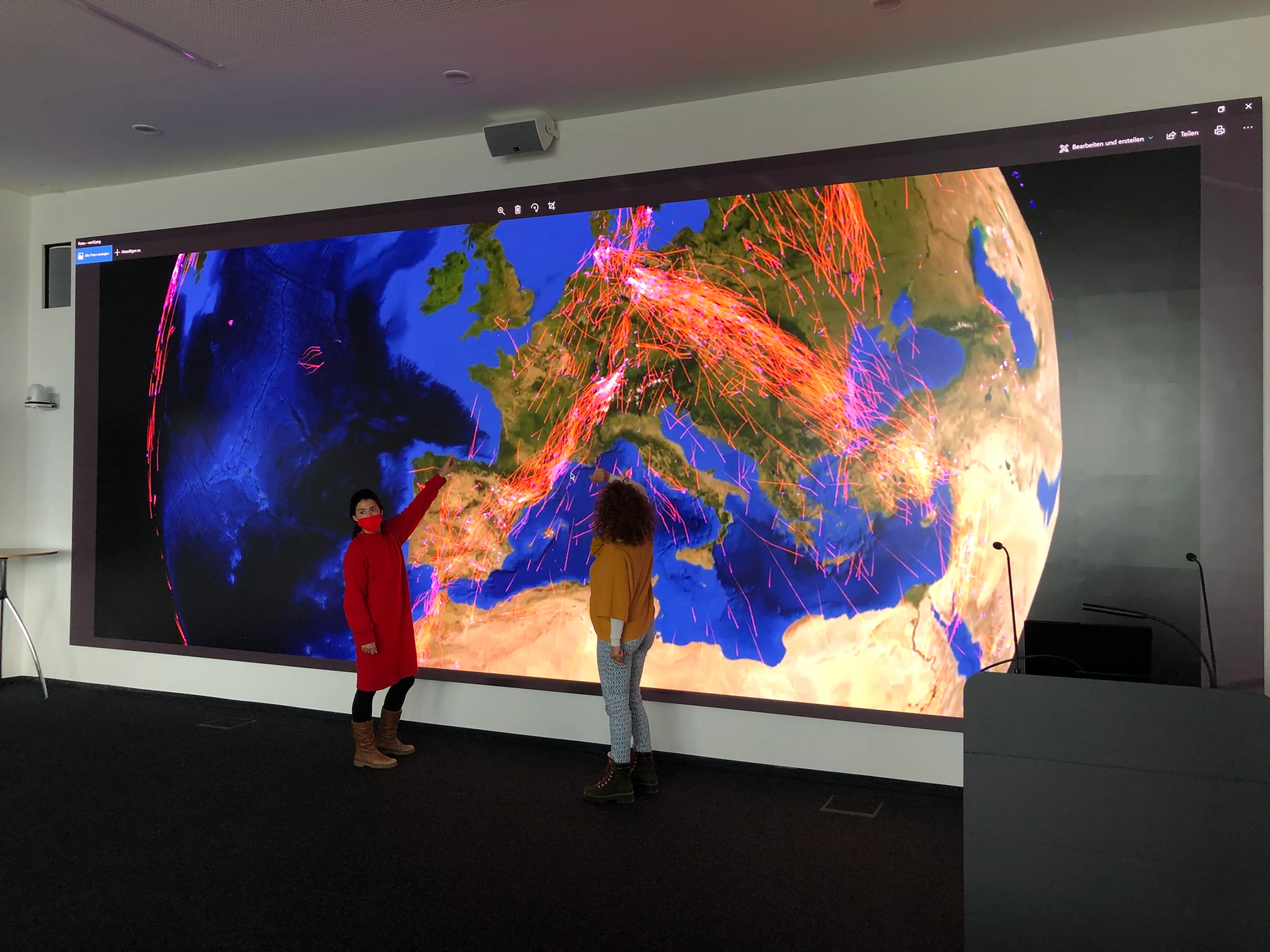
The Powerwall research facility is operated by the Data Analysis and Visualization Group (DBVIS) at the University of Konstanz, Germany, led by Prof. Dr. Daniel A. Keim. The research team includes Dr. Maximilian T. Fischer, Alexander Frings, Manuel Schmidt, and other postdoctoral and PhD researchers working on data analysis and visualization.
The facility has acquired an Analog Way Aquilon C+ 4K/8K multi-screen presentation system and videowall processor to drive its high-resolution Samsung videowall. The Powerwall provides the research team with a large-scale experimental environment for exploring complex data and developing and evaluating advanced visualization methods, including high-resolution and stereoscopic 3D visualization.
Located on the shores of Lake Constance, the young university is renowned for its strong research focus and modern infrastructure. It is globally recognized for its expertise in data analysis, visual computing, distributed systems and Artificial Intelligence and human-AI teaming.
“Our goal was not simply to build a large display wall, but to create a flexible platform for visualization research,” explains Prof. Dr. Daniel Keim.
“The system needed to handle large and complex datasets, multiple sources and very high resolutions.
“Researchers can use the entire Powerwall as a single, continuous visualization surface or divide it into independent areas for different content and applications.”
“A further objective was to explore the possibilities of stereoscopic 3D for research and visual data analysis. Flexibility was essential: As a research platform, the Powerwall needed to support not only existing applications but also experiments and visualization scenarios that had yet to be developed.”
Samsung’s The Wall IW008A LED videowall product was selected as the display along with an Analog Way Aquilon C+. The screen’s resolution of 9600 x 3780 works with Analog Way’s firmware, now with 3D and the full 120fps. The university was one of the drivers and beta test sites developing the 3D function from Analog Way. Bellgardt was the system integrator.
“As a central component of the Powerwall, Analog Way manages the distribution and presentation of content across the displays, allowing us to operate the wall either as one continuous surface or in their true resolution as multiple independent visualization areas with different sources. It also plays an important role in enabling our stereoscopic 3D setup,” reports PhD stundents Alexander Frings and Manuel Schmitdt
The decision to use Analog Way’s Aquilon C+ was made in close consultation with Samsung.
“The entire team, including Technical Administrator Giovanna Ratini, had a high level of confidence in Markus Zellner, who was a Samsung engineer at the time. Analog Way was the solution he recommended for this demanding configuration.”
“Analog Way’s image quality, LUT-based color calibration, 3D workflow, ability to mix 3D with 2D for seamless presentations, and the flexibility to be able to adapt to new requirements from researchers were among the benefits offered by the Aquilon C+,” says Zellner, Presales and Commissioning manager with Analog Way.
“For us, the key factors were modularity, flexibility and the ability to support the scale and resolution required by our research environment,” notes Dr. Maximilian T. Fischer . “What mattered was the combination of these capabilities and our confidence that the proposed architecture was the right fit for our particular requirements. With a project of this complexity, the expertise behind the technology is just as important as the specifications themselves.”
Prof. Dr. Daniel Keim points out that “the Powerwall was a pioneering project in terms of the resolution and 3D capabilities we wanted to achieve. When you choose to be among the first to implement something at this level, you know that the path may not be straightforward. There is not always an established solution for every technical challenge — sometimes you are among the first to encounter it.
“Through intensive technical work and close cooperation between Samsung and Analog Way, the system was progressively refined until we achieved a high-quality stereoscopic setup. The Powerwall has been in productive use for several years and is a stable part of our research infrastructure today. Markus Zellner's expertise, persistence and commitment, together with the technical support and responsiveness of Analog Way, were instrumental in bringing the Powerwall to its current level of performance.”
Prof. Dr. Daniel Keim emphasizes that “perhaps the most important point is that the Powerwall is not simply an audiovisual installation — it is a research instrument. Its purpose is to give researchers an environment in which they can experiment with new approaches to large-scale visualization and visual data analysis.
“In research, reaching the limits of existing technology is not necessarily just a problem. Understanding those limits can itself provide valuable knowledge and open up new directions. For that reason, we do not regard the Powerwall as a finished experiment. It is an evolving research platform that allows us to continue exploring what advanced visualization can make possible.”